
Sources for Milford Mill Previous Residents
Match each source to the era you need. A deed chain follows a Milford Mill parcel's legal transfers. Directories and Census schedules do different work. They place a person or household at an address on a stated date. Historic books and Archives series reach farther back than the modern portal. None proves every occupant between two dated entries.
| Source | Years It Covers | Where Held | What It Shows |
|---|---|---|---|
| Modern Baltimore County electronic land-record groups | COTT from 1964, CAIS from 1993, ELROI from 2005 | MDLandRec and related Archives guidance | Indexed parties, deed references, images where available |
| Baltimore County C352 land-record series | 1661-1851 | Maryland State Archives | Historic deeds and indexes for the county |
| C2363/T680 paper land-record books | 1851-1994 | Archives, paper books, and related research routes | Earlier book, page, party, and tract research |
| Baltimore Suburban directories | Cataloged examples: 1957, 1958, 1959, 1961, 1963, 1964; BCGS notes 1967 | State Archives, BCGS, BCPL, and Historical Society leads | Date-bounded address association, if the entry is present |
| Federal Census personal schedules | Released through 1950; 1890 largely lost | National Archives and genealogy-library routes | Enumerated household at a Census date |
Choose your first record by the question. Title history starts with the deed path. Household history starts with directories and Census schedules. Whatever the route, keep a source date, a record identifier, and the record's stated limitation with each name, so an old address association never gets presented as current fact. Both paths reward the same careful note-taking.
Note: Match the source to the era and the record role before combining names into one history.
Milford Mill Address Record Start
Milford Mill is a census-designated place in Baltimore County, not an incorporated city, so county and state systems hold its address trail. Start with the Maryland SDAT Real Property Search. Not every wording resolves. When a search stalls, compare a USPS-standardized delivery line, the county GIS locator, a historic street form, and a ZIP variant. Never silently swap a historic road name. Its modern look-alike may point somewhere else entirely.
Before chasing a deed, copy the SDAT fields as separate values. Capture the account or PIN, current deed liber and folio, plat reference, map, grid, parcel, block, lot, premise address, and owner or mailing entries. The owner field is a title lead. It does not prove occupancy. It gives no move-in date, and a mailing recipient may never have lived at the parcel.
Tracing Milford Mill Deed Records
A deed chain runs backward through legal transfers. The key bridge is the liber and folio that SDAT displays, since Baltimore County's land-record portal does not use the City's address-search approach. Search by party name, instrument type, recording date, or book and page. Open the image when access allows. Read the prior reference and legal description first.
- Normalize the current address in SDAT and record its account or PIN, deed liber and folio, plat clue, and parcel identifiers.
- Find the current purchase deed in Maryland land records using Baltimore County, the current party, the book and page, or another recorded identifier.
- Copy the recording date, grantor, grantee, instrument, legal description, subdivision or lot clues, and prior deed reference exactly as the image presents them.
- Search the buyer from that deed as a grantee to locate the earlier acquisition, accounting for spelling variants and historic address changes.
- Repeat the prior-reference and party search, then move to Archives indexes, microfilm, paper books, or the Circuit Court land-record counter when the electronic route ends.
- Use the Maryland plats search when a subdivision, lot, right-of-way, or recorded plat relationship needs confirmation.
- Grantor
- The party giving or conveying an interest in a deed.
- Grantee
- The party receiving the interest. Searching a later grantee can reveal that party's earlier purchase.
- Chain of title
- The documented sequence of conveyances for a property interest, traced by recorded references rather than a street name alone.
- Legal description
- The lot, block, metes and bounds, or other deed description that identifies the land more reliably than a changing street address.
Note: Record every liber, folio, party role, and prior-reference field before moving backward.
Milford Mill MDLandRec Records
The Archives MDLandRec portal is the modern landing point for Baltimore County title work. It searches records and serves images. It is not an address-to-history answer by itself. Maryland's 2025 update brought real changes: a new login with MFA, "Indices" renamed "Historical Indices," and Begins With, Ends With, and Contains modifiers on name fields. Screens and instructions shift. Save each search date accordingly.
The Baltimore County plats search is the companion route when a deed cites a subdivision, lot, right-of-way, or plat. Published fields include book, page, and plat or box. Date, description, series, and right-of-way information round out the entry.
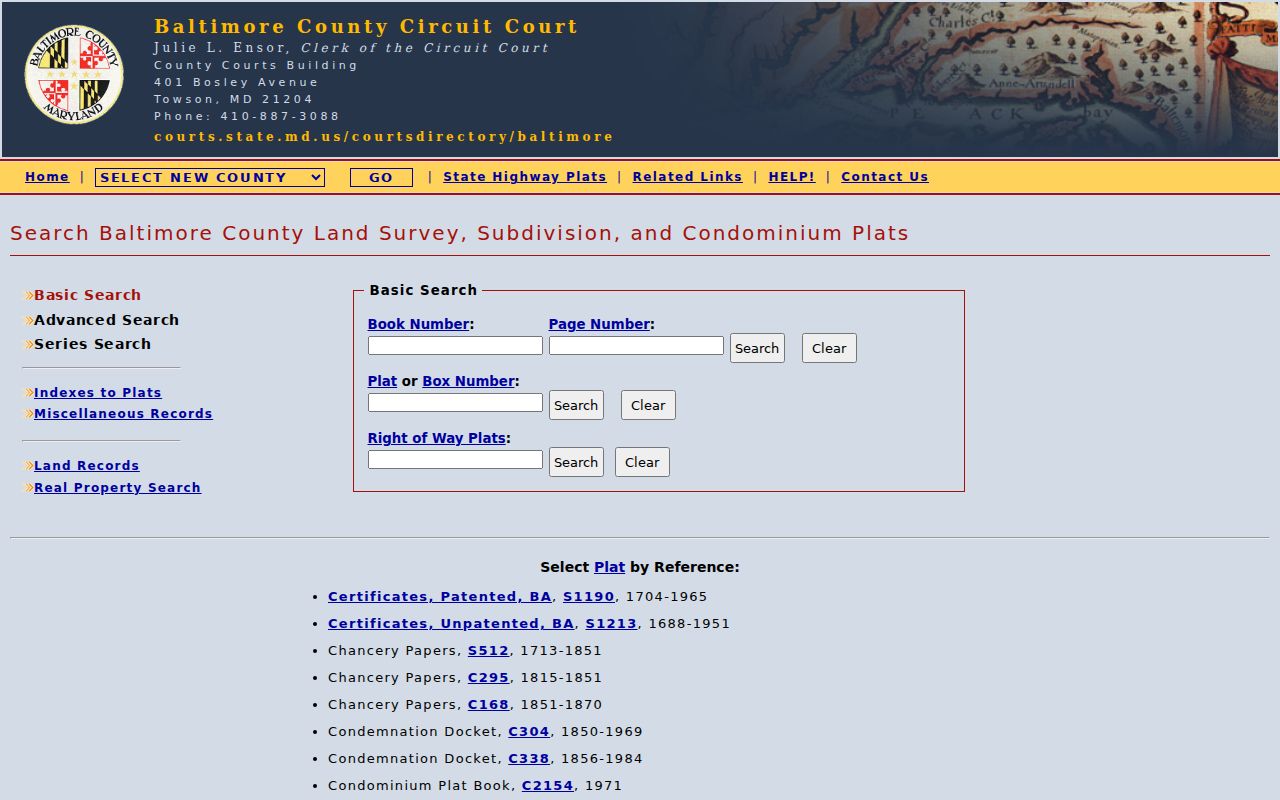
The plat interface is a finding tool, not a live county result. Pick Baltimore County. Narrow the pool by date or instrument. You can also use the SDAT liber or folio. A party role works too. So do book, page, and plat clues. A visible index row stays an index lead. Inspect the deed image and its prior reference first.
The Archives land-record guide explains access and the historical-index routes. An online gap can appear. Then turn to the Baltimore County Circuit Court land-record counter. Archives search-room materials help as well. So does the published help route, or a narrowly scoped request for an existing index or fee record. Ask for a record, not a project. No agency will reconstruct a complete chain.
Milford Mill Past Resident Directories
Directories answer the household layer of a Milford Mill property history, but only for the year and terms printed. A dated listing is one layer. It is not a claim of continuous occupancy. The Maryland State Archives lists Baltimore Suburban directories for 1957, 1958, 1959, 1961, 1963, and 1964. The Baltimore Genealogical Society adds a 1967 item. Exact Milford Mill page coverage is still a research gap. Search each annual volume under suburban and postal variants. Record the title, year, page, street number, street spelling, and the residence or business marker.
The Milford Mill city directories page holds the fuller collection and the entry-reading method. For an address history, use only relevant years. A directory collection does not establish an uninterrupted run. An owner on a deed and a person in a directory play different record roles. Each needs separate support.
Note: An absent directory year is a documented gap, not evidence that a household moved.
Milford Mill Census Records
Federal Census schedules add names, relationships, ages, and birthplaces. Later schedules add street addresses. The National Archives Census history explains the release rules and the record context. Personal schedules are public through 1950. The 1890 schedule was largely lost, so searches around that gap compare 1880 and 1900 instead of inventing the missing interval.
- Start with the exact printed directory address and date, including any old number, street spelling, or suburban label.
- Locate the nearest released Census year and capture the household composition, relationship fields, and address or place description as displayed.
- Compare the two dates without treating a matching surname as enough. Name changes, initials, and adjacent addresses need a second check.
- Use a death, marriage, cemetery, obituary, or probate lead to test a relationship or endpoint, not to fill a residence gap without dated address evidence.
An old residents directory entry paired with a Census household can pin a past resident to a Milford Mill address for a bounded span of years. What it cannot do is fill the gaps: no continuous residence between publication dates, and no proof that a name in a title chain ever actually occupied the parcel.
Milford Mill Street Record Variants
Addresses drift across records. That is the core problem in Milford Mill past-resident research. USPS, SDAT, and the county GIS can each print a different form of the same premise. An old street directory can too. Every form is legitimate. Record every variant in its own column. List the house number and street exactly as found, the current USPS delivery line, the county premise address, and the historical directory label. Do not treat a postal label as a municipal boundary, either. The county's 2012 ZIP map attaches nearby names such as Randallstown, Gwynn Oak, Pikesville, and Windsor Mill to parts of the area. That misleads plenty of lookups.
Historic records supply still more search strings for a Milford Mill resident lookup. The State Archives mill guide notes 1890 work at Milford Mill bridge. It also carries an 1892 reference to a former mill road. An 1896 ledger phrase reads, “Milford Road near Cox's Mill.” Search Milford Mill Road, Old Milford Mill Road, and Milford Road as separate queries in any city directory or property roll. Do the same for Cox's Mill and Milford Mill bridge. A road-history match is context. It never proves a named household lived at a parcel.
Milford Mill Vital Record Clues
Vital and probate sources work differently from an address source. But they can still close a name trail. The Maryland Division of Vital Records holds current and recent certificates. The State Archives keeps the older material, along with indexes, guides, and marriage orders. Birth certificates stay restricted for 100 years. The Archives death guide describes a ten-year restriction as well. Deaths from 2012 forward go to DVR, and pre-2012 deaths belong to the Archives.
Marriage access turns on date and record type. The Archives order route covers many Maryland county records from 1952 through 2011. Anything later routes to DVR. Probate can add another lead. The Maryland Estate Search and the Baltimore County Register of Wills both surface estate filings. A decedent, representative, or heir reference supports an estate relationship. It does not prove that a past resident lived at the Milford Mill address.
Milford Mill Lawful Research
House history, family trees, and estate questions all justify digging into dated public sources in Milford Mill. So does simple curiosity about a property. The limits deserve equal attention. Maryland records sometimes carry protected-party exceptions, substitute addresses, sealing orders, or redactions. An index entry is not always the full story. A residents directory listing gives you a lead, not permission to track or harass anyone, copy records in bulk, or work around an address-protection program.
Sometimes a portal simply omits a record that should be public. In that case, the Maryland Public Information Act lets you request an existing record from its custodian. The request must be narrow, though. The Attorney General's PIA FAQ spells out two boundaries. Agencies do not have to create a new record. They also do not have to answer broad research questions. Note: Ask for a known date, identifier, or existing field, not a freshly compiled occupancy list.
Recording Milford Mill Evidence
Log your evidence as you go. For every past-resident conclusion in Milford Mill, record the exact source and the search date. Note the query type and the address form you used. Add the liber or folio where applicable. Also record a page or image reference, the record's role, and any stated limitation. That discipline separates a confirmed deed image from a mere index lead. It also shows when a street directory or voter rolls entry supplies context only.
- CONFIRMED: a direct official record or image supports the statement.
- INDEX LEAD: an official index points to an image, book, or courthouse file for review.
- CONTEXT: a map, road history, or place source helps interpret the address but does not identify a household.
- NOT LOCATED: the named official source set produced no item and does not prove absence.
- RESEARCH GAP: an entry, page, live portal result, or local-coverage confirmation was not safely obtained.
Solid evidence in Milford Mill rests on matching one identifier across two fitting sources. A parcel PIN can be paired with a deed liber and folio. Together they make a title lead stand up. A residents directory entry can be set beside a Census household. That pairing anchors an address to a date range. When the records will not stretch further, leave the gap alone.